Winston AI
The most trusted AI detector setting the standard in AI content detection.
Updated 12d ago
Has API
PricingFreemium
Free to $49/mo
AI Content Detection
Plagiarism Detection
AI Image Detection
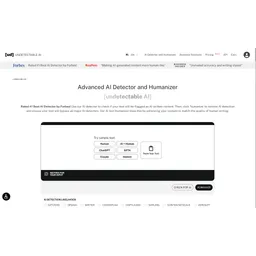
Make AI-generated content undetectable and human-like with advanced AI detection and humanization tools.

Undetectable AI provides a suite of tools designed to detect and humanize AI-generated content. Its AI Detector analyzes text structure, syntax, and stylistic elements to quantify the probability of AI involvement using multiple detector models. The AI Humanizer rewrites AI-generated text to make it appear human-like, slipping past AI detectors like Turnitin and Copyleaks. The platform supports integrations via API, allowing developers to incorporate its functionality into their own applications. Core value propositions include ensuring content authenticity, avoiding AI detection penalties, and maintaining high-quality writing standards for various applications. Use cases span from bloggers ensuring originality to SEO professionals maintaining search engine performance and academics verifying essay integrity. Undetectable AI utilizes advanced algorithms trained on vast datasets of both AI-generated and human-written text to achieve high accuracy and reliability.
Undetectable AI provides a suite of tools designed to detect and humanize AI-generated content.
Explore all tools that specialize in detect ai-generated text. This domain focus ensures Undetectable AI delivers optimized results for this specific requirement.
Explore all tools that specialize in ai detection. This domain focus ensures Undetectable AI delivers optimized results for this specific requirement.
Utilizes multiple AI detection models to analyze text and provide a comprehensive detection score.
Rewrites AI-generated text to mimic human writing styles, making it undetectable by AI detectors.
Allows users to create AI-generated texts that match a specific writing style.
Provides an easy-to-use API for integrating Undetectable AI's functionalities into custom applications.
Supports AI detection and humanization across multiple languages.
Analyzes images to determine if they are real or AI generated.
1. Create an account on Undetectable.ai.
2. Navigate to the AI Detector or AI Humanizer tool.
3. Paste your text or upload your file into the input area.
4. Click the 'Check for AI' or 'Humanize' button.
5. Review the results, including the AI detection score or the humanized text.
6. For API access, visit the 'Develop' page and obtain your API key after signing up.
7. Integrate the API into your application using the provided documentation.
All Set
Ready to go
Verified feedback from other users.
"Highly rated for its accuracy in AI detection and effectiveness in humanizing AI-generated content, praised for user-friendliness and quick processing times."
Post questions, share tips, and help other users.
The most trusted AI detector setting the standard in AI content detection.
Advanced AI content detection and writing enhancement tools.

Visual risk intelligence for preventing fraud using authenticated visuals and AI manipulation detection.
Academic-grade linguistic forensics for verifying research integrity and document provenance.

The global standard for AI detection and human-authored content verification.

Advanced linguistic fingerprinting to distinguish human-authored content from synthetic LLM outputs.