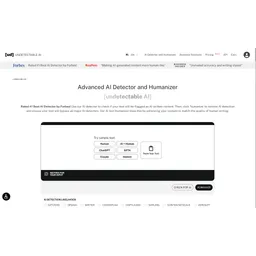
Undetectable AI
Make AI-generated content undetectable and human-like with advanced AI detection and humanization tools.
Updated 11d ago
Has API
PricingFreemium
Free to $31/mo
AI Content Detection
AI Content Humanization
Writing Style Replication

The most trusted AI detector setting the standard in AI content detection.

Winston AI is an AI content detection tool designed to identify text generated by various AI models, including ChatGPT, Google Gemini, and Claude. It uses a sophisticated detection model that is continuously updated to keep pace with the evolving landscape of generative AI. Winston AI offers a free basic scan, but the advanced scan (99.98% accuracy rate) requires a subscription. It supports file uploads and URL imports for analyzing content directly from web pages. The tool also offers features like sentence-level precision, shareable reports, plagiarism checking, and writing feedback. It utilizes a credit-based system for paid plans, with different credit costs for AI detection, plagiarism checks, and AI image detection. Winston AI aims to help maintain content integrity in academic, SEO, and writing contexts.
Winston AI is an AI content detection tool designed to identify text generated by various AI models, including ChatGPT, Google Gemini, and Claude.
Explore all tools that specialize in detect ai-generated text. This domain focus ensures Winston AI delivers optimized results for this specific requirement.
Explore all tools that specialize in verify content authenticity. This domain focus ensures Winston AI delivers optimized results for this specific requirement.
Explore all tools that specialize in plagiarism analysis. This domain focus ensures Winston AI delivers optimized results for this specific requirement.
Employs a sophisticated algorithm with a 99.98% accuracy rate to detect AI-generated content.
Identifies specific sentences within the text that are likely AI-generated, allowing for targeted review and refinement.
Generates professional reports detailing the AI detection results, which can be easily shared with stakeholders.
Detects plagiarized or improperly sourced content to ensure originality and academic/professional integrity.
Provides actionable suggestions to improve content clarity, tone, and structure.
Detects AI generated images and deepfakes. Provides forensic details on images including C2PA, Exif, and IPTC data.
Sign up for a free account.
Navigate to the AI detection tool.
Paste the text into the provided text area or upload a document.
Select the desired scan type (Basic or Advanced).
Click 'Scan for AI' to initiate the analysis.
Review the generated report to understand the AI content score and flagged sentences.
Sign up for a paid plan to unlock advanced features like plagiarism checking and extended text analysis.
All Set
Ready to go
Verified feedback from other users.
"Customers praise Winston AI for its accuracy and helpfulness in identifying AI-generated content, but some find the pricing model limiting."
Post questions, share tips, and help other users.
Make AI-generated content undetectable and human-like with advanced AI detection and humanization tools.
Advanced AI content detection and writing enhancement tools.
Detect deepfakes and AI-manipulated media with enterprise-grade AI models.

A decentralized, blockchain-based protocol for peer-to-peer content distribution and digital sovereignity.
Advanced linguistic fingerprinting to distinguish human-authored content from synthetic LLM outputs.
Enterprise-grade linguistic fingerprinting for identifying generative AI patterns in academic and professional content.